Real-time battles, surprising upsets, and tracking who's winning the future.
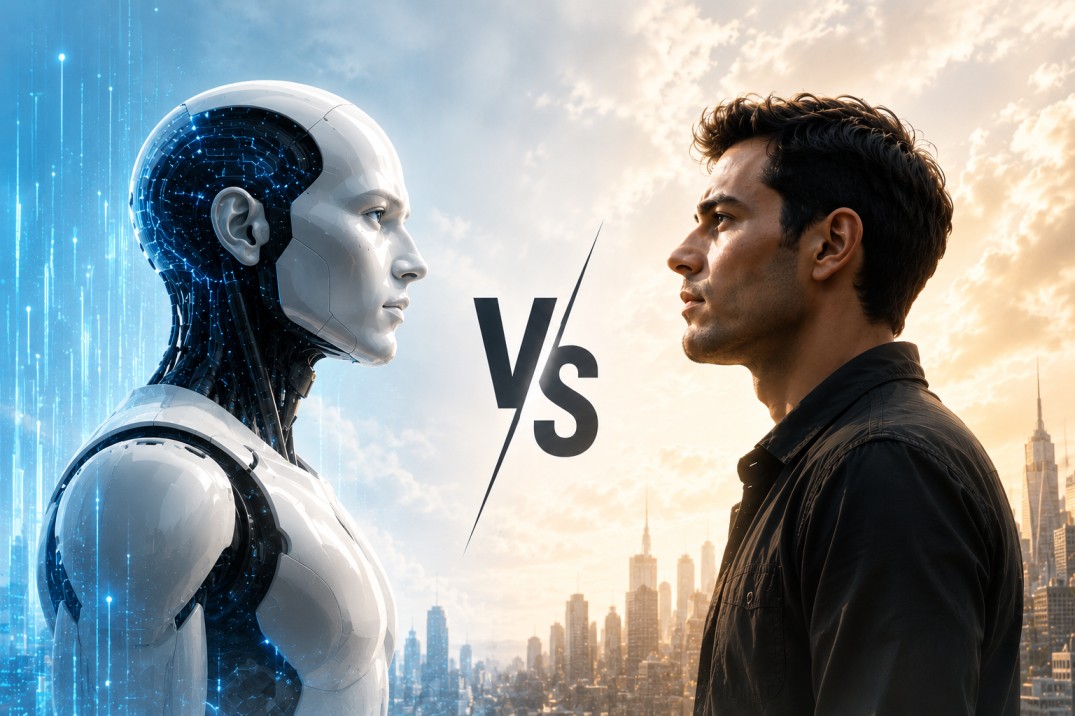
Explore face-offs categorized by key benchmark capabilities between humans and machines.
In a viral showdown, former NASA engineer Mark Rober created an "unbeatable" robot goalkeeper to test against football legend Cristiano Ronaldo . This wasn't your average shot-stopper. The machine used 22 high-speed infrared cameras, tracking the ball at 500 times per second to predict its trajectory within 6 milliseconds of impact . Powered by two 50-horsepower motors, it could rocket across the goal at 66 km/h to block shots traveling up to 128 km/h—giving it reaction times that would put any human keeper to shame .

At first, the robot was impenetrable, stopping Ronaldo's powerful strikes with ease. But the Portuguese superstar adapted, finding a mechanical flaw. He exposed a tiny, unreachable gap in the robot's coverage and, with pinpoint precision, slotted the ball into the back of the net . As one report noted, Rober attributed the goal to a bent transport rail, but Ronaldo's clinical ability to identify and exploit the weakness sealed a narrow victory for humanity .
While machine precision and reaction time are already superhuman, human adaptability and game intelligence are still unmatched. Expect this to be a tight contest for the next 5-10 years, until AI systems can learn and adjust their strategies on the fly as effectively as a player like Ronaldo .
The chess world's ultimate showdown isn't against a human rival—it's against the machine. World Chess Champion Magnus Carlsen (peak rating 2882) versus Stockfish, the open-source engine that has crushed all competition and now sits at a staggering ~3300 rating.
Stockfish examines over a mind-boggling 100 million positions per second—a level of computational depth no human can match. When Carlsen has faced Stockfish in unofficial matches, the engine consistently outcalculated him, exposing even the world's greatest player to its terrifying precision.

The battle was lost long before Carlsen. The crossover moment came on May 11, 1997, when IBM's Deep Blue defeated reigning world champion Garry Kasparov in a six-game match, winning 3.5 to 2.5 . The final game lasted barely an hour—Kasparov resigned on the 19th move, a stunning collapse that marked the first time a computer had defeated a world champion in a match of several games .
The machines won over 25 years ago. Humans haven't beaten the best chess computers since. Modern top-level chess has become a war of attrition where engines evaluate positions to 0.00—"draw death." The crossover isn't coming. It happened.
In a 2025 MrBeast showdown, Olympic 100m champion Noah Lyles faced three robots in a 50m sprint. The first two fell easily. Then came "Black Panther 2.0"—a four-legged robot from Zhejiang University designed to emulate a cheetah's speed. It reached 35 km/h (22 mph) and nearly caught him. Lyles held on. Humans won 4-3. But the margin? Terrifyingly thin.
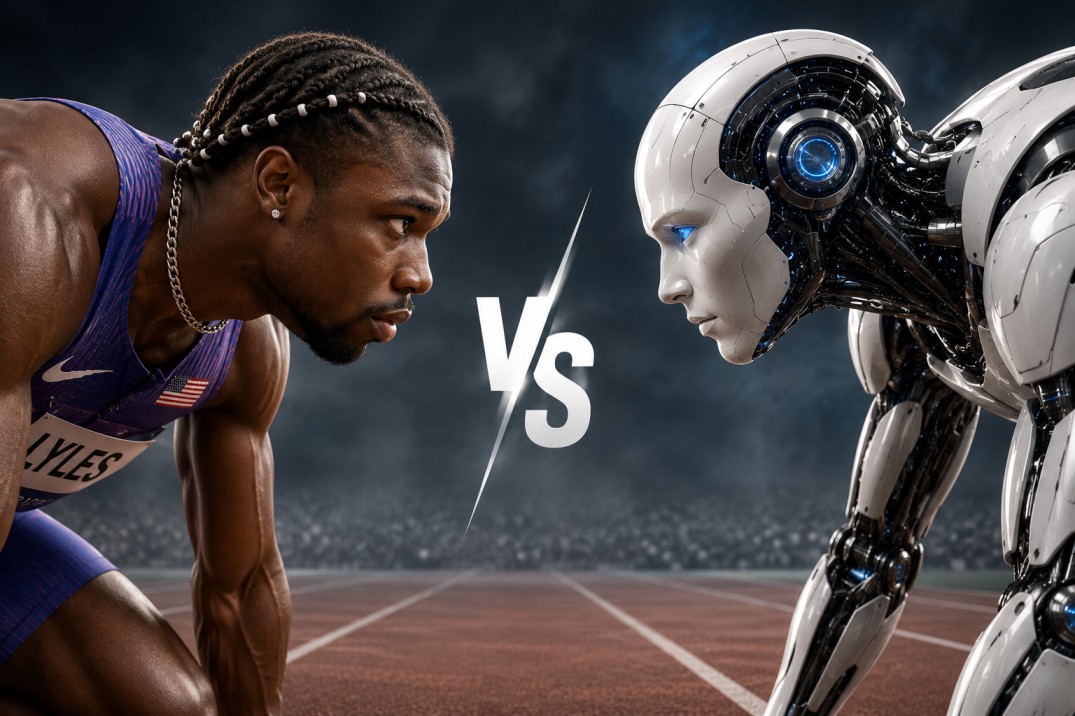
The robot's peak speed already exceeds Lyles' (13.2 m/s vs. ~12.1 m/s) and surpasses Usain Bolt's 12.4 m/s limit. Lyles won because the robot hasn't yet solved acceleration and stability. As MrBeast put it: "One day robots will overtake us. But in 2025, humans still have an edge."
Raw sprint speed falls to machines by 2028–2030. Black Panther 2.0 went from 10.3 to 13.2 m/s in 30 days—faster than any human can improve in a lifetime. The next generation targets 15 m/s. Once robots crack acceleration and outdoor stability, the 100m world record belongs to them.
The robot already runs faster than Bolt. It just can't start yet. Give it 5 years.
In April 2025, Sony's AI-powered table tennis robot "Ace" faced five elite athletes — players with 10+ years of experience and 20 hours of weekly training. Ace won three of five matches and seven of 13 games. By March 2026, after improvements, Ace won matches against seven ranked professionals — including Miyuu Kihara, World No. 26 in women's singles and two-time Olympic silver medalist Miu Hirano. After losing to Ace, Hirano asked simply: "It's really strong. Is there really anyone who can beat this?"

Ace is not a humanoid — it's a stationary system with nine cameras, three event-based vision sensors, an eight-axis robotic arm, and an AI controller based on reinforcement learning. It captures the ball's position in 3D 200 times per second and estimates rotation using several hundred measurements per second. Sony chief scientist Peter Stone compares the achievement to Deep Blue defeating Garry Kasparov in 1997 — the first time an autonomous robot has beaten professional-level humans in an adversarial sport under official rules.
In controlled, predictable environments like table tennis, machines will dominate by 2028. But in dynamic, unpredictable sports with physical contact and real-time adaptation? That's 15–20 years away.
Ace can't cook you dinner. But from the baseline? It's already a grandmaster.
In April 2025, Sony's AI-powered table tennis robot "Ace" faced five elite athletes — players with 10+ years of experience and 20 hours of weekly training. Ace won three of five matches and seven of 13 games. By March 2026, after improvements, Ace won matches against seven ranked professionals — including Miyuu Kihara, World No. 26 in women's singles and two-time Olympic silver medalist Miu Hirano. After losing to Ace, Hirano asked simply: "It's really strong. Is there really anyone who can beat this?"
.jpg)
Ace is not a humanoid — it's a stationary system with nine cameras, three event-based vision sensors, an eight-axis robotic arm, and an AI controller based on reinforcement learning. It captures the ball's position in 3D 200 times per second and estimates rotation using several hundred measurements per second. Sony chief scientist Peter Stone compares the achievement to Deep Blue defeating Garry Kasparov in 1997 — the first time an autonomous robot has beaten professional-level humans in an adversarial sport under official rules.
In controlled, predictable environments like table tennis, machines will dominate by 2028. But in dynamic, unpredictable sports with physical contact and real-time adaptation? That's 15–20 years away.
Ace can't cook you dinner. But from the baseline? It's already a grandmaster.
%20(2).jpg)
Real-time battles. Surprising upsets. Track the ultimate face-off in skill, speed, and smarts—across every challenge.
See who’s crushing it right now in chess, code, art, and more. The scoreboard updates as the action unfolds.
Humans, AI, and robots go head-to-head. From slam dunks to sonnets, check out the wildest matchups and results.
Guess when machines will take the crown. Explore bold forecasts and community bets for every skill.
Cast your vote—human or machine? Rankings shift with every pick. Shape the leaderboard in real time.
Who’s calling checkmate? Dive into the latest moves, see who’s ahead, and predict the next big win.
![[interface] ai healthcare research interface on a laptop screen](https://cdn.prod.website-files.com/6a59e6c870ebbbc71bf81cf8/6a59ea344de76eaad94678b3_e07c0e0d-1e2a-4958-88ad-c413be637ada.avif)
Ready to see who’s on top? Sget real-time stats, predictions, and leaderboard access. Human, AI, or robot—track the race your way.
Get full access and perks for $4/month or $39/year.
Epic face-offs, frame by frame



See who’s crushing it right now. Track epic showdowns, surprise upsets, and the latest leaderboard shifts—updated live.


Morgan Patel
Classic brains vs. code. Can a chess legend outplay the latest AI challenger in a lightning-fast duel?

Skyler Brooks
AI and human poets battle for the mic. Whose verses will spark the loudest cheers?
![[interface] image of software interface (for a edtech)](https://cdn.prod.website-files.com/6a59e6c870ebbbc71bf81cf8/6a59ea344de76eaad94678b0_45bab170-9e8e-4f30-8a93-90cf7261b542.avif)
Riley Chen
Human, robot, and AI coders race the clock. Who’ll crack the code first?
Cast your vote. See real-time scores. Predict the next champion. Ready to tip the balance?

![image of a customer service representative working in a digital interface environment [digital project]](https://cdn.prod.website-files.com/6a59e6c870ebbbc71bf81cf8/6a59ea344de76eaad946787b_6b900d47-aab7-43f9-bb47-71a4f4d4bf14.avif)